Explanation
My Cosmological Site
www.steady-state-universe.net
Alternative Cosmology with a
Native touch.
| |
THE
MYTH OF AURVANDILL AND AMLETH
An analysis of
the Aurvandill (Amleth) Myth.
Introduction from Wikipedia
http://en.wikipedia.org/wiki/Hamlet_(legend
The names Aurvandil or Earendel (Old
Norse:
Aurvandil;
Old English:
Ēarendel;
Lombardic:
Auriwandalo;
Old High German:
Orentil,
Erentil;
Medieval
Latin:
Horuuendillus) are
cognate
Germanic personal names, continuing a
Proto-Germanic reconstructed compound
"Auziwandilaz "luminous wanderer", in
origin probably the name of a
star or
planet, potentially the morning star (Eosphoros).
As a
Germanic name, Auriwandalo is attested
as a historical Lombardic prince. A
Latinized version,
Horvandillus appears as the name of
the father of
Amleth (Shakespeare's
Hamlet) in
Saxo Grammaticus'
Gesta Danorum. German
Orentil is the hero of a medieval poem
of the same name. He is son of a certain Eigel of Trier and has numerous adventures
in the Holy Land. The Old Norse variant
appears in purely mythological context,
linking the name to a star. The Old English
word refers to a star exclusively.
Horwendill was a
legendary
Jutish chieftain,
who is the prototype for
William Shakespeare's
King
Hamlet,
Prince Hamlet's father. He appears in
Chronicon Lethrense and in
Saxo Grammaticus'
Gesta
Danorum (book 3).
The
Chronicon Lethrense (and the included Annales Lundenses) tell
that the Danish king
Rorik Slengeborre put Horwendill (who he calls Orwendel) and
Feng as his rulers in
Jutland, and
gave his daughter to Horwendill as a reward for his good services. Horwendill
and the daughter had the son
Amblothe (Hamlet).
The jealous Feng killed Horwendill and took his wife.
Saxo Grammaticus has a slightly different
version of events. Saxo states that Horvendill and Feng were the sons of
Jutland's
ruler Gervendill, and succeeded him as the rulers of Jutland. On his return from
a
Viking
expedition in which he had slain Koll, king of
Norway,
Horvendill married Gerutha, the Danish king
Rřrik Slyngebond's daughter, who bore him a son
Amleth. But Feng, out of jealousy, murdered Horvendill, and persuaded Gerutha to become his wife, on the plea that he had committed the crime for no
other reason than to avenge her of a husband by whom she had been hated.
Etymology.
The
*auzi- a compound form of *auzaz,
the word found in the
Anglo-Saxon goddess name
Eastre, the holiday name
Easter, and the term
East, ultimately cognate with
Hausos (Ushas),
the Proto-Indo-European dawn goddess (Pokorny
(1959)). The second element is from the
root wand-, whence also English to
wend.
Eastre; Ēostre derives from
Proto-Germanic *austrō,
ultimately from a
PIE root *au̯es-, "to shine" and
closely related to the name of
the dawn goddess,
Prose Edda.
Aurvandil is mentioned once in
Norse Mythology, in
Skáldskaparmál, a book of
Snorri Sturluson's 13th century
Prose
Edda:
- Thor went home to Thrúdvangar,
and the hone remained sticking in his head. Then came the wise
woman who was called
Gróa, wife of Aurvandil the Valiant: Gróa sang her spells
over Thor until the hone was loosened. But when Thor knew that, and
thought that there was hope that the hone might be removed, he desired
to reward Gróa for her leech-craft and make her glad, and told her these
things: That he had waded from the north over Icy Stream
(Élivágar) and had borne
Aurvandill in a basket on his back from the north out of Jötunheim.
And he added for a token, that one of Aurvandill's toes had stuck out
of the basket, and became frozen; wherefore Thor broke it off and
cast it up into the heavens, and made thereof the star called Aurvandill's Toe. Thor said that it would not be long before Aurvandill came home: but Gróa was so rejoiced that she forgot
her incantations, and the hone was not loosened, and stands yet
in Thor's head. Therefore it is forbidden to cast a hone across the
floor, for then the hone is stirred in Thor's head.
- Thrúdvangar
-
- In
Norse mythology, Ţrúđvangar (anglicized Thrúdvangar or
Thrudvangar) or Ţrúđvangr (anglicized Thrúdvang or Thrudvang)[1]
, which means "Plain(s) / Field(s) of strength" in
Old
Norse, is the home of
Thor
according to
Snorri Sturluson,
- Gróa
-
- In
Norse mythology, Gróa (Old
Norse "growing"[1])
is a
völva and practitioner of
seiđr, the wife of
Aurvandil the Bold.
Jötunheimr
(often anglicized Jotunheim)
is the world (heim 'home, homeland') of the
jötnar (two types: rock (or hill giants) and frost (or rime giants))
in Norse Mythology. From there they menace the humans in
Midgard
and the gods in
Asgard
(from whom they are separated by the river
Ifing).
http://en.wikipedia.org/wiki/J%C3%B6tunn
Élivágar
In
Norse mythology, Élivágar (Ice Waves) are
rivers which existed in
Ginnungagap at the beginning of the world.
The
Prose Edda relates:
- The streams
called Ice-waves, those which were so long come from
the fountain-heads that the yeasty venom upon them
had hardened like the slag that runs out of the
fire,-these then became ice; and when the ice halted
and ceased to run, then it froze over above. But the
drizzling rain that rose from the venom congealed to
rime, and the rime increased, frost over frost,
each over the other, even into Ginnungagap, the
Yawning Void.
Gylfaginning 5,
Brodeur's translation
The analysis of
the Aurvandill (Amleth) Myth.
- Of course the story is
often told as a historical event. Life has more dimensions and everything is
interpreted accordingly to the individual actual world of perception.
This mythical story
really deals with a spiritual learning: Amleth and Feng is the two
characters of an individual in a spiritual/mythical initiation process with
the goal to learn of the knowledge of the male (Aurvandill) and the female
(Groa) galactic/Universal qualities i. e. The Story of Creation.
Feng are the physical
character that threaten to take over the spiritual Amleth in a male person.
It is Amleths task to become a spiritual grown up person in order to
incorporate the knowledge of his spiritual Giant Father, Aurvandill and of
the knowledge of his spiritual Giant Mother. If succeeded in this task,
Amleth become a King on Earth representing the wisdom of the Heavenly
Kingdom.
According to the inherent
(somewhat secularized) story telling, the male deity of Thor is just inserted in
the text as a telling technique or by a mix up story with 2 deities from 2
cultural periods and therefore he also equals our hero Aurvandill. But then
again: The male deity quality of Thor also can be a guiding spirit in this
spiritual learning process of Amleth.
- Everything but the bold
text above can immediately be excluded as mere speculations. The bold text is
pasted here below as the key text and keywords in the Myth.
The bold text is inserted
from above and down:
-
"Auziwandilaz
"luminous wanderer"
-
(Thor) went home
from Thrúdvangar
-
"Plain(s) /
Field(s) of strength"
-
(Thor´s
hone remained sticking in his head.)
-
Then came the wise
woman who was called Gróa
-
Gróa, wife of Aurvandil
-
Gróa sang her
spells over
-
Thor
had waded
-
from the north
over the Icy Stream, (Élivágar)
-
(Thor) had borne
Aurvandill in a basket on his back from the north out of Jötunheim.
-
one of
Aurvandill's toes had stuck out of the basket
-
Thor broke it off
and cast it up into the heavens
-
and made thereof
the star called Aurvandill's Toe
-
Thor said that it
would not be long before Aurvandill came home
-
Gróa was so
rejoiced that she forgot her incantations
-
and the hone was
not loosened, and stands yet in Thor's head.
-
Gróa, völva and
practitioner of seiđr.
-
Jötnar
(two types: rock (or hill giants) and frost (or rime giants)
-
Élivágar (Ice
Waves) are rivers which existed in Ginnungagap at the beginning of
the world.
- In the Norse Mythology
The World is divided in 3 dimensions: Midgaard for Humans; Asgaard
for the nearer celestial objects of Sun, Moon, 5 Planets, Stars and Star
constellations; and the third dimension is Udgaard for the Gigantic Milky
Way figures.
Besides Thor, Feng and
Amleth, we have the
2 key figures: Aurvandill and Groa (Growth) as wife and husband. Therefore
they are both Giants and the main quality of Aurvandill (Auziwandilaz) is
"luminous wanderer". The luminosity maybe is a kind exaggerated or
misunderstood, because we are talking of the predominant white color of the
Milky Way, all though the atmosphere makes the stars sprinkle in many
colors. But the "luminous wanderer" is a very precise description of a giant
male figure seemingly wandering in the Night Sky because of the Earth
rotation.

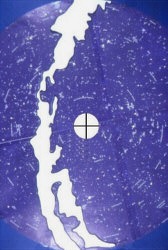
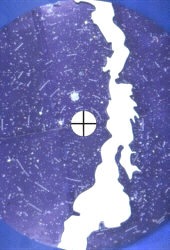
The Northern and the
Southern Earth hemispheres showing the Udgaard Giant Milky Way contours.
Here are the Giant Father God Thor/Aurvandill to the left and his giant
wife, Groa to the right. The "hone stone in Thor´s head" is the triangle
shaped figure highest up on the figure, that also is symbolized in many
other ways: A sword; an axe; a hammer; a drinking horn; a blowing horn and
also as the honed shaped headdress. When thinking of the myth of Thor and
the hone stone, it is a perfectly logical symbol for the sharpening of the
arms of the great deity.

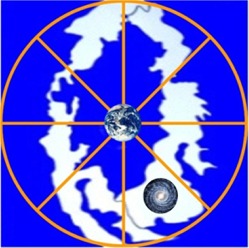
The division of the Earth
Hemispheres also tells of the 3 Earth Worlds of (The north Earth) Upperworld
with the male character; the Middle World (Equatorial Area) and the third
world female character of the Underworld. Hamlets Mill or Quern is not really Hamlet's but Aurvandill's. His mill/wheel origin from the Earth north celestial
Polar Center, above symbolized by the inserted Earth in the middle.
The most significant
quality of Groa, the Giant Mother Goddess is that she is the matrix of all
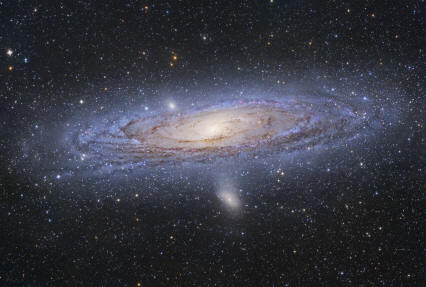
life in our Galaxy, here symbolized with the Galaxy Swirl on the right
figure, which gives origin to the whirlpool/quern
in the myth.

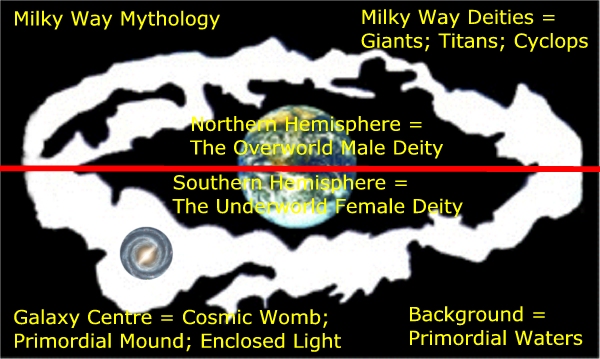
The Earth hemispheres Milky Way contours
picturing the Great Male and Female deity, Hamleth above and Groa below with the
inserted churning Milky Way Whirlpool Centre.
That is: We have 2 Mills:
Aurvandill Mill tells of the Earth night knowledge of the Stars and the
celestial pole and Groa Mill tells of
the Story of Creation in our Galaxy, hence her incantations of seiđr of the
female Galactic Wisdom of all Life that once was - and still is - born out
of this center of Eden.

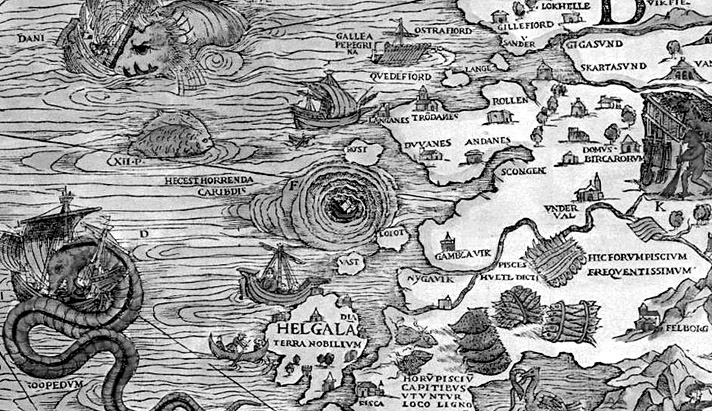
The story of our Whirlpool/Malstrom
galaxy deals with the story of life and not as a "horrenda caribdis"
somewhere in the North Sea outside the coast of Norway.

- If you got the general
idea of a myth, it is fairly easy to explain. With some spiritual help the
difficulties was/is eased for me. After my "cultural chocks" in the
beginning of some visions and dreams, I got very much spiritual help.
The Giant Mother Goddess
When comparing the
Mythological story of our Milky Way Galaxy this tells
of the modern cosmological misunderstanding, that everything is sucked
inwards in a black hole in our Milky Way galaxy. The quite opposite is in
fact the case: The movement in our galaxy is going outwards form the center,
hence the expulsion from the Garden of Eden and away from the central Tree
of Life.

Several Mills/Wheels are
needed in order to tell of the interaction between the Earth, the Solar
System and the Galaxy.
Aurvandills Foot.
One of Aurvandill's foots "is in the
crescent basket of the Milky Way contour", but the other one is hanging out
from the basket and out in the Élivágar, the river that is connected to the Ginnungagap Creation Story, which again is connected to the swirling and
churning Milky Way Center.

That is: Aurvandill's Foot, and not
just his toe of one foot, is "hanging" out of the Milky Way
Crescent/Basket/Boat in the direction of the Milky Way River and the Groa
Womb Galactic Center. "Thor broke it off and cast it up into the heavens,
and made thereof the star called Aurvandill's Toe". That is again:
Not a toe, but the whole one foot and not as a Star, but as a part of the
"Milky Way contours" called the "Footprint of the God" in many cultures.
No wonder there are so much cultural
confusion over the myths: Many cultures have several layers of deities that
deals with the very same myth - and when the idea of the myth is completely
forgotten, nothing can be taken for granted.
NB: By the way: The hone stone still
sits on the Milky Way head of Thor/Aurvandill Milky Way figure . . . But the
story it self is very true.
Se also:
The Divine Hero
THE
BOOK OF HAMLETS MILL
Hamlet's Mill (first
published by Gambit, Boston,
1969) by
Giorgio de Santillana (a
professor of the history of
science at MIT) and
Hertha von Dechend (a
scientist at Johann Wolfgang
Goethe-Universität) is a
nonfiction work of history
and
comparative mythology,
particularly the subfield of
archaeoastronomy. It
resembles
Joseph Campbell's
The Masks of God.
Its essential premise is
that much mythology and
ancient literature has been
badly misinterpreted and
that they generally relate
to a sort of
monomyth conveying
significant scientific and
specifically astronomical
ideas and knowledge.
Link to online Book here:
http://www.bibliotecapleyades.net/hamlets_mill/hamletmill.htm#top
Sir
Francis Bacon
Quote
from this site of Sir
Francis Organization:
http://www.sirbacon.org/mham.htm
:
Santillana and Dechand in concentrating on the
fact that the ancients knew about the precession of the equinoxes
missed the relation of the macrocosm/microcosm doctrine to the plight
of Hamlet.
They came close. They realized the story was
associated with the legends of the "Golden Age", and with those great
motifs of myth having to do with the "World Tree": The Ash Yggdrasil
in the Edda; the world-darkening oak of the Kalevala; Pherecydes'
world-oak draped with the starry mantle.
They even realized the story
was associated with The Garden of Eden, and with the Tree of Life in
The Garden of Eden. They neglected to emphasize the tree on which the
golden apples grew in the Garden of Hesperides.
This tree included
two additional features of the Garden of Eden story. It not only grew
in a Garden, there was also a serpent connected with it. The "Eden"
of the most ancient Egyptian mythology was a "circumpolar paradise."
The Garden of Hesperides was also in the extreme north. Numerous
writers on star lore identified the dragon which guarded the golden
apples in the Garden of Hesperides as the constellation of Draconis.
Draconis was the pole constellation about the time the Garden of Eden
story was supposed to have taken place, and would have been located
in the topmost area of the branches of the world-tree. In ancient
astronomical mythology Draconis was the old serpent, the evil one. Draconis is related to the stories of the Fallen Angels in the books
of Genesis and Enoch. A number of authorities on astronomical
mythology have claimed Draconis represented the tempter of Eve in the
Garden of Eden. William Olcott said: "The constellation Draco and Hercules are
closely associated in ancient mythology, and Hercules is always
represented as trampling the Dragon underfoot. These two
constellations are in turn connected with Ophiuchus and Serpens,
the figure of another giant overcoming a serpent, while he crushes
the Scorpion under his feet. On the old maps the figures of these
two famous giants appear head to head.

The Draco constellation as a
center point for the
Ecliptic Pole around which
the Earth Axis pole wanderer
1 degree for every 71.6 year
= 25.776 years cycle.
(My comment: If talking
about the Earth axis and the
serpent symbol, we must talk
of 2-3 serpents: 1 in the
north and one in the
southern hemisphere, and
maybe 1 representing the
Earth equator. The northern
relates to the Draco
constellation as seen above
here, but the southern
relates to a much larger
serpent, namely the curled
up Serpent that symbolizes
the Milky Way spiraling
shape.)
These similar and striking groups, placed so
close together in the sky, show clearly that there was a
deliberate intention on the part of the inventors of the
constellations to emphasize the great fact of a struggle between
mankind and serpentkind. There seems here an evident reference to
God's interview with the serpent in the Garden of Eden. 'I will
put enmity between thee and the woman, and between thy seed and
her seed. It shall bruise thy head and thou shalt bruise his
heel."
Although in ancient times Draconis had a place
at the top of the World-tree he was cast down. With the precession of
the equinoxes Polaris moved up to take his place. More striking
still, as Santillana and Dechend point out, according to the ancient
mythologies, at the time Draconis was at the top of the pole-tree the
plane of the ecliptic lay in the same plane with that of the equator.
This meant days and nights were equal year round. There was an
"eternal" spring. Then, due to some great misfortune, the plane of
the ecliptic was dissevered from the plane of the equator. The axis
of the earth was tilted. The serpent was cast down. That ancient
pair, Orion and Virgo, passed down from their place on the plane of
the ecliptic below the equator to winter and death.
The important point Santillana and Dechend failed
to note was the fact that the story also had to do with the ancient
doctrine of the macrocosm and the microcosm which maintains that
changes in the macrocosm are reflected in the microcosm. If they had
taken a closer look at the Garden of Eden story they might have
stumbled upon this fact that they overlooked.
Before looking at the story of the Garden of Eden
it is well to take a closer look at Moses himself, since it was his
story, and the context points back to the Egyptian
priesthood.
We are assured by St. Paul that,"Moses was learned
in all the wisdom of the Egyptians." Actually this goes without
saying. As a member of the royal family of the pharoah (the adopted
son of the daughter of the pharoah) Moses would have been required to
be initiated into the Egyptian Mysteries. The wisdom of the Egyptians
was maintained in the temples and withheld from all except the
initiates.
The great center of Initiation in Egypt at the
time of Moses, and indeed, up to the time of Christ, was reputed to
be the Great Pyramid. It was a custom of Initiates in their written
works to leave for other initiates, who might see their works, some
sign denoting their school. A examination of Exodus reveals that
Moses did, as a matter of fact, leave such a sign, and in a most
clever manner also.
Moses built a tabernacle in the wilderness as a
temple for his priesthood just as the Great Pyramid was the temple
for the priesthood of the Egyptian Initiates. Moses gave curiously
exact instructions for the curtains of the outside of this
tabernacle:
"And thou shalt make curtains of goats'
hair to be a tent covering the tabernacle: eleven curtains shalt
thou make. The length of one curtain shall be thirty cubits, and
the width four cubits: and the eleven curtains shall all be of one
measure. And thou shalt couple five curtains by themselves, and
six by themselves, and shalt lay the sixth curtain double over the
front side of the tent."
All of this detail indicates secret intent. A
close examination reveals the diagonal of the twice mentioned second
curtain (30 cubits by 24 cubits) yields a very significant angle.
This angle is the pitch of the side of the Great Pyramid! The side of
the Great Pyramid has a pitch of 51 degrees, and 51 minutes, and the
diagonal of any rectangle constructed in the proportion of 30 x 24
has the same pitch. (For more detail see, "The Secrets of Ancient
Geometry" by Tons Brunes).
As an Initiate of the Great Pyramid School, the
writings of Moses offer a great opportunity for learning more about
their doctrine. He did not take the trouble to leave the trademark,
without also leaving the doctrine. A portion of this doctrine is in
The Garden of Eden story.
A major aspect of the Garden of Eden story had to
do with the serpent. This was (My comment: Was NOT, see below) Draconis. The Great Pyramid was
oriented to Draconis. We know that, due to the precession of the
equinoxes, various stars or constellation take their place during the
vast 25,800 year cycle as the pole star. Draconis is one of these,
but Draconis has a special place because it is actually at the pole
of the polar ecliptic. In order words when Draconis was the Pole
Star, the ecliptic would have coincided with the equator.
Days and
nights would have been equal year round, and there would have been
spring year round, a golden age. Everyone knows the story of The
Garden of Eden. God created a garden. In the midst of the garden He
put the tree of life, and the tree of the knowledge of good and evil.
My comment: The concept of
"good and evil" is confused
for the concept of
"opposite". We have 1
serpent on the northern
Earth hemisphere in the star
constellation of Draco and
we have 1 serpent on the
OPPOSITE southern Earth
hemisphere, which together
tells of the cosmological
knowledge of everything in
our Galaxy, our Earth; the
Sun; the Moon and Planets;
the location of our Solar
System in the galaxy - and
which 4 elements that
created it all from the very
beginning - and even before)
http://www.native-science.net/Forefather.Worship.htm
In the Garden He also put Adam and Eve, the first man, and the first
woman. They were not supposed to eat of the fruit of these two trees,
but the serpent enticed Eve into eating of them, and Eve enticed
Adam. As a result God cast the serpent down. He will go on his belly
and eat dust all the days of his life. And God cast Adam and Eve out
of the Garden of Eden.
(My comment: When talking of
The Garden of Eden and a
serpent, we are dealing with
the Story of Creation in the
center of our Galaxy. "And
God cast Adam and Eve out
of the Garden of Eden" means that everything in our Milky Way Galaxy once was
born DIRECTLY OUT FROM THE
GALACTIC CENTER IN THE STAR
CONSTELLATION OF SAGITTARIUS
- quite the opposite of what
modern cosmologists and
astrophysicist tell us).
Link:
http://www.steady-state-universe.net/
Galaxy Creation)
Hamlet (legend)
http://en.wikipedia.org/wiki/Hamlet_(legend
TOP
|